
| Getting your Trinity Audio player ready… |
For anyone managing multiple LinkedIn profiles or automating activity, account safety isn’t optional — it’s mission-critical. In this regard, proxies for LinkedIn automation are your first helpers in growing your outreach without raising unnecessary red flags.
There’s just one condition: they have to be the “right proxies for LinkedIn automation” — ones that keep everything running smoothly behind the scenes while you get busy with pitching, handling objections, closing deals, you name it.
- What Is LinkedIn Automation Proxy?
- Why Proxies for LinkedIn Automation Matter?
- How Does LinkedIn Detect Automation in 2026?
- Types of Proxies for LinkedIn Automation
- Datacenter Proxies
- Residential Proxies
- ISP Proxies
- Mobile Proxies
- Server Proxies
- How to Choose The Right Proxies for LinkedIn Automation
- Avoid LinkedIn Jail with Proxy Background Check
- Stick To One Proxy Per LinkedIn Account
- Keep It Human
- Opt for Static Sessions Over Rotating Proxies
- Use Dripify LinkedIn Automation Tool with Pre-Built Proxies
- Key Takeaways
The wrong IP setup, however, can create inconsistencies that LinkedIn’s systems notice fast — and that’s when problems start.
So, how do you choose the best proxies for LinkedIn automation that support steady growth without putting your profiles at risk? We’ll guide you through every step, starting with the basics.
What Is LinkedIn Automation Proxy?
A LinkedIn automation proxy is an IP address that acts as a middle layer between your LinkedIn account and the platform. It masks your real IP address, leading LinkedIn to interpret the activity as originating from another location.
Why Proxies for LinkedIn Automation Matter?
Whether we like it or not, LinkedIn constantly monitors user behavior on the network. Automation without a proxy, especially at scale, can raise flags and even trigger the LinkedIn account restricted message.
Proxies for LinkedIn are indispensable in the following situations:
- You manage multiple LinkedIn accounts simultaneously.
- You’re doing outreach or lead generation at scale using an automation tool.
- Your team operates from the same office IP range.
- You’re targeting prospects in specific geographic regions.
- You’ve previously triggered login challenges on an account.
How Does LinkedIn Detect Automation in 2026?
In 2026, LinkedIn’s detection evolved from simple rate limits to a system that analyzes patterns in how someone behaves on the platform over time.
Typically, when you log in, the system captures a snapshot of your digital fingerprint: your browser, your cookies, and, more importantly, your IP address and your LinkedIn activity.
- IP repute: If an IP address has a history of spam activity or ties to bot networks, LinkedIn flags it instantly
- Session consistency: If your location appears to jump from Frankfurt to Singapore to Dallas within 30 minutes, it may be treated as automation or a compromised account.
- Transparent GEO: An account registered in Toronto suddenly operating from multiple Brazilian IPs within a short window raises red flags. Even legitimate travel can trigger verification checks.
💡Pro-tip! Many VPNs focus on basic connectivity without accounting for LinkedIn’s behavior-based detection systems. You get an IP address, but it carries baggage you can’t see until an important notice from LinkedIn lands in your inbox.
Some cheap proxies fail because they are “dirty,” meaning they recycle IPs that were blacklisted months ago. Among these, many belong to the infamous datacenter proxies range that LinkedIn has already categorized as “non-human.” You inherit that bad reputation the moment you choose these IPs.

Types of Proxies for LinkedIn Automation
When you start shopping around, you’ll run into a lot of different types of proxies for automating LinkedIn. Each proxy has a unique risk profile. A clear understanding of the pros and cons is vital for choosing the right LinkedIn proxy.
Datacenter Proxies
Datacenter proxies are servers hosted in physical data centers. They’re cheap and fast but carry the highest detection risk. LinkedIn can easily tell the IP belongs to a datacenter, not a real home or office.
Residential Proxies
These are IP addresses that Internet Service Providers (ISPs) give to regular home users. They’re considered the most reliable option.
When you use residential proxies for LinkedIn automation, your traffic looks like it’s coming from a real person sitting in a house somewhere in Chicago or Manchester. If you are using a LinkedIn automation tool IP matches the expected user behavior, making it harder for the algorithms to find out such activity.
The trade-off? They are usually more expensive than most other types of proxies.
ISP Proxies
Often confused with residential, ISP proxies are a hybrid — owned by data centers with the IPs registered as residential addresses. They offer a balance of speed and authenticity. For LinkedIn, they are a solid middle ground as they’re less likely to trigger suspicion.
Mobile Proxies
Mobile proxies for LinkedIn automation operate through cellular networks, mimicking users accessing LinkedIn via smartphones — a common, expected behavior. The traffic rotates naturally because carriers assign dynamic (constantly changing) IPs to users.
If you’re doing heavy verification or app-based work, mobile proxies for LinkedIn automation are excellent as they carry low risk. But they come at a premium price.
Server Proxies
Server proxies come from cloud hosting providers such as AWS or OVH. LinkedIn can quickly recognize these IPs because they originate from well-known cloud hosting services rather than traditional ISPs.
So, which proxy types are cheap vs premium?
- Cheap but risky proxies → datacenter or server proxies.
- Mid-tier (balance of safety and cost-effectiveness) → ISP Proxies.
- Premium (lowest risk, high cost) → Residential proxies and mobile proxies.
💡Pro-tip! Cheap proxies are tempting — we get it. But if you buy a bundle of 50 IPs for ten bucks, you’re likely buying a list of IPs that have been abused by hundreds of other users.
They are often flagged, slow, or blacklisted, which increases the risk of getting your account flagged even if you’re using the best LinkedIn automation tools and software.
How to Choose The Right Proxies for LinkedIn Automation
While many users overlook it, choosing proxies for LinkedIn automation with the best safety standards is essential to staying compliant.
Here’s how to find the right LinkedIn automation proxy:
Avoid LinkedIn Jail with Proxy Background Check
Before selecting a proxy provider, run a quality check on sample IPs. Some proxies were used for spam before, whereas others were part of scraping networks. They’ve got a bad reputation, and LinkedIn knows it.
Services like IPQS (IP Quality Score) and IP2Location allow you to check the history and track record of a proxy. You want a score that indicates low risk to prevent LinkedIn from blocking your account. If you’re serious about learning how to avoid LinkedIn Jail picking a positive risk rating is a smart move.
💡Pro-tip! It is a good approach to ask providers for trial IPs and test at least five of them for every geographic location you plan to target.
That’s because some providers give you clean IPs in New York but recycled garbage in London. Quality and consistency across regions are vital.
Stick To One Proxy Per LinkedIn Account
A good rule of thumb is to use one proxy per LinkedIn account because sharing IPs across multiple profiles increases correlation risk (similar pattern).
LinkedIn tracks the IP history and behavior. If two accounts are run from the same IP, LinkedIn knows they are connected. If one of them gets restricted for spam, the other is instantly on the watchlist.
Also, remember to start slowly. Use a new proxy with one profile for a few days at reduced activity levels while keeping an eye out for login issues or unusual alerts.
If everything stays quiet, you’ve likely found a workable proxy.
Keep It Human
This is something many people overlook. A good proxy gets you in the door, but staying inside requires human-like behavior. Even the cleanest residential proxy won’t save you if you blast 300 connection requests between 2:03 AM and 2:17 AM.
You need to spread your activities across realistic working hours and avoid repetitive sequences to keep within LinkedIn’s healthy limits.
💡Pro-tip! Here’s an ideal daily range to start with for extra protection of your account: 30–50 connection requests, 100–150 messages, and 150–200 profile views per day (spread evenly across different intervals).
If you push through these limits, LinkedIn’s security system may catch you.
Opt for Static Sessions Over Rotating Proxies
Standard rotating proxies swap and juggle with your IP address every few minutes or with each request. If your IP changes mid-session or frequently across sessions, LinkedIn might assume it is an account compromise, VPN use, or automation.
Static proxies are the way to go because they keep the same IP for a longer period, ideally across your entire session and multiple sessions. This uniform pattern builds trust with LinkedIn, which helps keep your session stable and the algorithm relaxed.
Use Dripify LinkedIn Automation Tool with Pre-Built Proxies
Instead of searching for separate proxies and spending time testing them, pick Dripify automation software with built-in proxy infrastructure. Dripify handles proxy management for you — so your automation stays compliant, stable, and on the safe side from day one.
See, what it’s got for your safety:
Human-mimicked LinkedIn Automation
Comes with smart delays for connection requests, likes, profile views, and messages — all for your activity to look natural, credible, and unlikely to raise suspicion, even when you’re scaling outreach.
Activity Control Feature
An algorithm that keeps an eye on your account’s performance and key factors like pending connections, account type, and past activity.
Based on that, it automatically adjusts your daily connection and messaging limits so your LinkedIn activity grows gradually and looks natural — not random or spammy.
Working Hours Feature
Lets you choose exactly when Dripify sends connection requests, messages, and runs other sequence actions. By keeping automation within these defined hours, your LinkedIn activity follows realistic daily usage patterns — just like a real person working during the day.
Outside your set hours, Dripify pauses all actions to avoid unusual activity and reduce the risk of suspicion.
Cooling Down Feature
Serves to detect sudden spikes in activity or repeated failed actions that could look risky, it automatically triggers a temporary “cool-down” period.
During this time, automated actions are completely paused. This acts as a protective measure, helping your account avoid sudden activity bursts that could trigger LinkedIn’s monitoring systems — and reducing the risk of restrictions or suspension.
Unique IP & Stable GEO
When a user registers for a Dripify account for the first time, they’re assigned a unique IP that closely matches their real location.
If the system detects a login from a new location, the user is prompted to confirm it as part of the platform’s security measures. Should the user actually change locations, the IP can only be updated through customer support to maintain account safety.
Key Takeaways
- The best proxies for LinkedIn automation prioritize IP reputation and session stability.
- Residential proxies and mobile proxies carry lower detection risk than datacenter proxies.
- Cheap proxies often reuse IPs with abuse history.
- One proxy per LinkedIn account reduces correlation signals.
- Static sessions are safer than rotating proxies.
- Monitor for login challenges and verification alerts.
- Keep daily LinkedIn activity within healthy limits.
- Tools with built-in proxy infrastructure simplify management and reduce risk.
Recommended For You
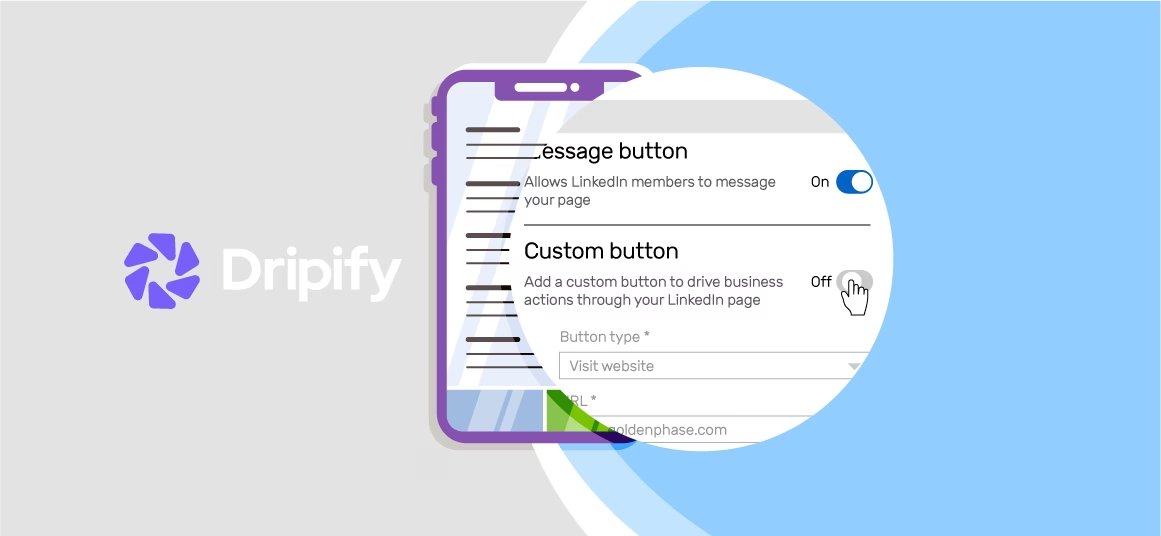
LinkedIn Call to Action for Lead Generation
LinkedIn has always been at the forefront of introducing new and exciting features to help businesses make the best use…
![Email Outreach Tracking [Tips, Tricks and Tools]](https://dripify.com/wp-content/uploads/2025/02/11-7-png.avif)
Email Outreach Tracking [Tips, Tricks and Tools]
Email outreach is one of the most effective and affordable marketing tools available to reach your target customers. As a…
![Create a Prospecting Plan [+8 Prospecting Methods]](https://dripify.com/wp-content/uploads/2025/02/11-png.avif)
Create a Prospecting Plan [+8 Prospecting Methods]
No matter your business, you need a steady flow of new prospects for a steady revenue stream. Prospecting is time-intensive…

Try out a smarter way to crush sales
Kickstart your sales outreach campaign today and see your first results in less than 48 hours, while enjoying your free trial
10 people or more? Get a personalized introduction to Dripify